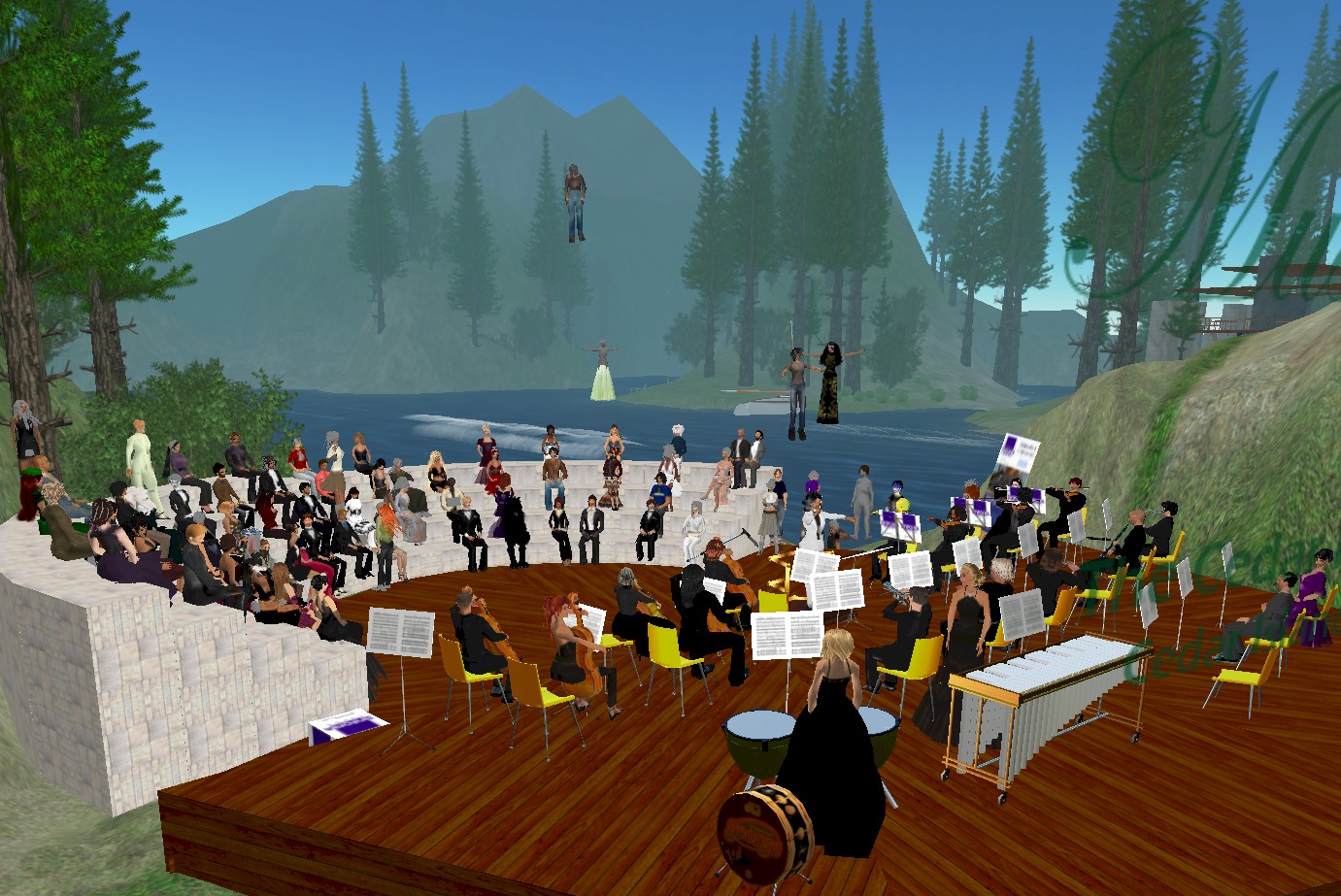
Pictured above, is a “live” concert by British community orchestra Sinfonia Leeds in the virtual world of Second Life. The concert appeared in virtual reality within an open-learning community Cedar Island, where I reside in my Second Life identity as Kate Miranda. Organizing and presenting concerts Music Island is part of my work and play within Second Life.
People unfamiliar with virtual reality usually have a few main questions:
1. How does it work?
2. Why present classical music in Second Life?
3. Who is performing in Second Life and what is there motivation?
How it works:
The performer or ensemble use microphones or instrument pickups to capture a live performance. That performance is encoded as an MP3 stream (usually using one of three popular programs Winamp, Simplecast, or SAM) and uploaded to a ShoutCast server on the Web. Meanwhile in Second Life, a venue owner tunes the media channel the URL to the streamed music.
At the same time the performers are using their computers to position their Second Life avatars to “play” virtual instruments, in fact triggering animations. Performers also can use the stream to introduce their works by speaking into a computer head set microphone or by using their avatars to text introductions.
Why present classical music in Second Life?
Well first let’s deal with the principal objections. The sound is no better than any podcast on the internet and the animations are not really linked with sound production in any way–something some consider a bit of a sham.
Both true.
The principal reason for presenting classical music in Second Life, for me, revolves around the quality of the audience experience. Listening to a podcast or recording is a solitary experience. By contrast, concerts in Second Life are joyfully social, audience members are joyfully celebratory in their anticipation and appreciation of the music in a way rarely matched in real life orchestras. Unique to the medium, listeners silently text appreciative comments, hurrahs, and questions that they hope someone more informed will be able to answer. Sometimes Second Life avatars even decide to dance to the music in the manner of small children at a summer concert at the park.
Conversations quickly reveal that many of those attending classical concerts in Second Life have little or no experience of live classical music. While classical music series are having trouble attracting new audiences to conventional concert stages, it seems that the internet virtual audience is open to the experience of art music. It seems worth it to step into the virtual world to reach out to this new audience.
The other unique element to the SL live concert experience is the accessibility of artists. Performers can view texted messages and questions. They usually engage the audience before and after concerts and sometimes at breaks in the program. This accessibility is as rewarding to the performer as to the audience.
Not to be minimized is the “fun” factor. Even audience members and performers who are regulars in the real world concert hall are amused, engaged and refreshed by the experience of classical music in the context of virtual reality.
Who is performing in Second Life and what is their motivation?
Classical performers in second life range from competent amateurs, music students, music educators, plus emerging and mid-career professional musicians.
Love of the music and interest in virtual reality is common to everyone performing in second life. You have to think it’s just a gas to be bothered. Those without a sense of humour will not be amused.
Some performers find it is a good way to work up new material and play it before a live audience before facing an audience in the concert hall. For students it is a way to get more live concert experience. For educators, a way to keep performance skills sharp.
Performers are warmed by the appreciation of the audience and the sense that they are reaching new audiences.
While some hope to promote real life careers and boost earnings, this last goal is more difficult. The requirement to have a pseudonym in Second Life hobbles name recognition. As Second Life evolves into a serious platform for art, corporations, and learning, this role-play with fictional names seem more and more out-dated.
On Music Island we have been getting around the name recognition issue with posters, T-shirts and even virtual CD stands with links to performers’ real world websites.
Anyone interested in learning more about classical music in Second Life should join the Classical Group in-world. Please contact me–Kate Miranda–if I can help you or answer your questions.