Looking for a great holiday theatre experience for students?

If you are in travelling distance of Toronto you won’t want to miss this great event!

Puppetmongers @ the Tarragon Extra Space
7 School Shows only
December 15 through 18, 2009
10 am and 1:30 pm

History and fun are integrated in this imaginative retelling of the classic fairy tale. Puppetmongers reset the story in 1834, just as “Muddy” York is to be renamed Toronto, and Ella is expected to cater to every whim of her just-off-the-boat-from-England stepmother and sisters. With a little magic and some imaginative special effects she does get herself to the Ball, and to the satisfying conclusion of the tale. The play is ingeniously staged with a traditional marionette theatre that transforms, as the story unfolds, into scenes evoking the wilderness, pioneer life and early Canadian society.

This is a Cinderella that Canadian children can call their own!

Single Tickets: $8.00

Book the whole theatre of 100 seats for $700

more info at: http://www.puppetmongers.com

Bread and Roses Life, L. Rogers

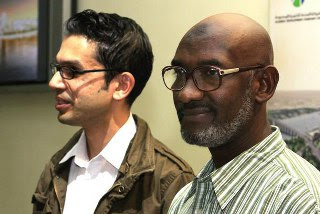
Abousfian Abdelrazik Speaks in Toronto


Forwarded from TASC

Delist and Desist!
Stop Canadian Involvement in Torture.
Abousfian Abdelrazik Speaks in Toronto
With an Introduction by Dr. Sherene Razack

Thursday, October 8, 2009, 7:15 pm
Steelworkers Hall, 25 Cecil Street (just west of St. George, south of
College)
Free.

Abousfian Abdelrazik is a Canadian citizen who was detained, interrogated, and tortured in Sudan with the complicity of our own government (see http://peoplescommission.org/en/abdelrazik/ for further background). Indeed, the Federal Court of Canada found earlier this
year that spy agency CSIS was complicit in his detention.

His six-year saga of trying to come home to his loved ones (including a year-plus stay in a small corner of the Canadian embassy in Khartoum) was blocked at every stage by a variety of levels of the Canadian government, including CSIS and the Department of Foreign Affairs.

Never charged, he was beaten, threatened and tortured during two periods of detention. Abdelrazik was interrogated by CSIS officials, and separately by Sudanese and French intelligence agents and the FBI. The Canadian embassy was instructed by the Canadian government that: “Mission staff should not accompany Abdelrazik to his interview with
the FBI.”

Released and cleared of all suspicion by Sudan in 2006, and then by the RCMP and CSIS in late 2007, his many attempts to return home to Montreal were repeatedly blocked.

The grass roots efforts of hundreds of people across Canada led to a historic court order that forced the Canadian government to allow Abdelrazik to come home. He was finally reunited with his family in June of this year. Yet his struggle continues.

His name remains on the United Nations 1267 list. This list imposes a travel ban and complete asset freeze on listed individuals. Canadian regulations implementing the 1267 list prohibit anyone from providing Abdelrazik with any material aid – including salary, loans of any
amount, food or clothing. This makes it impossible for him to live a normal life.

Abdelrazik was not told that he was being placed on the list, was not told why he was on the list, and was given no opportunity to defend himself. As Federal Court Judge Russel Zinn said in his ruling forcing the government to let Abdelrazik return, “There is nothing in the (1267) listing or de-listing procedure that recognizes the principles of natural justice or that provides for basic procedural fairness.”

No one has been held responsible for the grave injustices and terrible violence he has suffered.

As Abdelrazik undertakes the challenge of recovering a life of dignity for himself and his family, Mr. Abdelrazik is coming to Toronto as part of a national speaking tour so that he can meet his supporters and share his story in person. It is his hope to be “delisted” from the UN list, and to see true accountability at the federal government level.

Mr. Abdelrazik’s horrific experience is part of a broader Canadian pattern of involvement in torture, and his talk on October 8 kicks off a speakers series that will focus on other cases of Canadian complicity in the most brutal human rights abuses imaginable. Watch for future
speaking events featuring Abdullah Almalki (http://www.abdullahalmalki.com/), individuals subject to secret trial security certificates, a focus on Canadian involvement in the U.S.-based School of the Assassins, Benamar Benatta (http://benamarbenatta.com/), and more.

(Dr. Sherene Razack is a professor, Sociology and Equity Studies in Education, the Ontario Institute for Studies in Education of the University of Toronto. She is also the author of the remarkable Casting Out: The Eviction of Muslims From Western Law and Politics as well as
Dark Threats and White Knights: The Somalia Affair, Peacekeeping and the New Imperialism)

Organized by Stop Canadian Involvement in Torture and Christian Peacemaker Teams Canada, endorsed by the Centre for Integrated Anti-Racism Studies (CIARS) at OISE.

Sponsored nationally by Project Fly Home, the Canadian Labour Congress (CLC), Council of Canadians, Council on American-Islamic Relations – Canada (CAIRCAN), International Civil Liberties Monitoring Group (ICLMG), and the National Campus and Community Radio Association (NCRA).

If you cannot make it to the Toronto event, Mr. Abdelrazik is speaking in many other parts of Canada. See his schedule at http://peoplescommission.org/en/abdelrazik/events.php

For further information: tasc@web.ca, (416) 651-5800 ext. 1

Bread and Roses Life, L. Rogers

Rogers Communications television advertisement promotes ageism

“My name is Mary, and I’ve just discovered the Internet, but I know it is the future” said the gray haired woman on a recent Rogers Communications television advertisement.

As an age contempory of “Mary”‘s I wanted to scream and throw a cellphone at the screen… but luckily my cellphone service is Bell.

But let’s think about the premise of this advertisement. Unless “Mary” has been living under a rock for the past couple of decades, she has likely been using computers for most if not all of her working life. If, like me, she is a veteran of the punch card, DOS and early word-processing programs, she likely can run rings around some younger people in understanding her computer and getting it to do what she needs.

I know that there was once a time when I thought of computers as being “the future”. That was in the 1960’s when I was an elementary school student and we had an opportunity to learn some simple programming using computer punch cards, prior to the silicon chip, or later in university when, as a theatre student I got to play around with some of the earlier Moog synthesizers and made some early experiments in computer-generated video art with a Sony portapak.

I’m an artsey, not a computer whiz kid but computers have come into mainstream aspects of my life since the 1980’s. I learned my first wordprocessing program on a Commodore 64 and in 1985 I was hired in an office job that required me to create a simple database for a YWCA branch in a new program called Q & A. I taught myself DOS, in order to write the batch files needed to sort the data, and became the office “computer expert” by being one step ahead of the rest of the staff in computer knowledge.

In the 1990’s it was easy for those of us that had used older wordprocessing programs like Easy Script or Wordstar to learn html as the codes for centering, emboldening, tables, etc. were exactly like those we had learn to format text for print output. I took to website design like a duck to water, creating sites for volunteer organizations, family, and work projects for my various arts and non-profit employers. Mail lists and e-newsletter creation have been a part of the arts marketing strategy in all of my organizations for about 12 years.

These days I’m an avid user of social media, a blogger, and coordinate a cutting edge arts series in virtual reality. In my various management positions I have trained many entry staff members to use computer software on the job. I can attest to the fact that being able to text friends or Twitter a photo does not mean that the employee will be able to generate mail merges, use accounting software, has the basics of desktop publishing, can navigate a spreadsheet, or can print a simple mailing label.

Obviously, the Rogers ad struck a very sour note with me but in all seriousness, the advertisement is seriously out-of-step with reality and does a real disservice to the many working men and women with up to date job skills but who struggle with the type of age prejudice evident in the Rogers advertisement. On what basis did Rogers think that a late 50’s woman would be credible as someone “just discovering the internet”? Would they make the same supposition about a visible minority member and not expect a backlash?

I hope that all of the women my age let Rogers know what they think about their recent media campaign. For a company that has had some very clever advertising, this one is just dumb.

Bread and Roses Life, L. Rogers

Will technology provide the means to a renewal of participatory democracy?

Forwarding on a press release that I got in my email today about an interesting presentation in virtual reality. I have been thinking a lot lately about the almost religious fervor people have for social media and their belief that it is going to change the world. There are some powerful communication tools out there. One only needs to look at tweets (twitter posts) with the hashtag #iranelection to see how ineffective shutting down news is these days when anyone with a cellphone, a blackberry, or a laptop can get news out. That’s the encouraging news.

On the discouraging front, this past week my husband asked his online group of teachers. (These are all practicing teachers already engaged in teaching our kids) to use a wiki to do some collaborative writing for a group projects. He set up the wiki in the very user-friendly Wikispaces platform. All four of the project groups rebelled. They found using a wiki too complicated and no one had “trained” them on this tool. Sigh. I wondered aloud if they needed someone to train them on the use of a pencil since wiki’s are almost as common a writing tool in our current era.

But that is the dilemma. We have these great tools but only the technologically literate are truly using them. While I intend to write more on this, here’s the information on this Monday’s talk. It’s worth dropping into Second Life for.

Beth Noveck talks about Wiki Government in Second Life on July 20th!

Please join a Second Life simulcast, from the Markle Foundation, of Beth Simone Noveck, now the deputy Chief Technology Officer at the White House responsible for Open Government, presenting her new book, WIKI GOVERNMENT: How Technology Can Make Government Better, Democracy Stronger, and Citizens More Powerful. The presentation will be followed by a Q&A, in which participants from both Second Life and in person can ask questions of the author.
In the digital age our lives are constantly being transformed by the way in which we connect and collaborate with one another, affecting the way we make decisions – on a personal level, an institutional level, and a national level. Drawing on her expertise, and more directly her experience in creating Peer-to-Patent, the federal government’s first social networking initiative, Ms. Noveck’s Wiki Government insightfully demonstrates how technology, along with citizen participation, can help the government become more open and effective at solving the complex social and economic problems we face today.
The event will begin at 12:00pm EST/9:00am PST on Monday, July 20, 2009 and will take place in Second Life on MacArthur Island (click here to teleport http://slurl.com/secondlife/Foundations/109/231/34).
———————————————–
Further information
WIKI GOVERNMENT: How Technology Can Make Government Better, Democracy Stronger, and Citizens More Powerful
In the digital age our lives are constantly being transformed by the way in which we connect and collaborate with one another, affecting the way we make decisions – on a personal level, an institutional level, and a national level.
Beth Simone Noveck’s book provides a coherent and compelling “new vision of governance in the digital age – collaborative democracy – government with the people.”
Drawing on her expertise, and more directly her experience in creating Peer-to-Patent, the federal government’s first social networking initiative, Ms. Noveck’s Wiki Government insightfully demonstrates how technology, along with citizen participation, can help the government become more open and effective at solving the complex social and economic problems we face today.
About the Author:
Beth Simone Noveck is the United States deputy chief technology officer for open government and leads President Obama’s Open Government Initiative. Based at the White House Office of Science and Technology Policy, she is an expert on technology and institutional innovation. Previously, Noveck directed the Institute for Information Law & Policy and the Democracy Design Workshop at New York Law School. She is founder of the “Do Tank,” and the State of Play Conferences, and launched the first of its kind Peer-to-Patent Community Patent Review project in collaboration with the United States Patent and Trade Office. As a professor of Law at New York Law School, she has taught in the areas of intellectual property, innovation, and constitutional law, as well as courses on electronic democracy and electronic government.
Bread and Roses Life, L. Rogers

Will more public engagment or more electronic media be the future of the arts


While recently the Met was reported to be contemplating replacing its’ summer programming with filmed performances shown on the big screen, the public was more engaged in filming and tweeting about the 30 public pianos that the city of London had placed on the streets.

“They’re out there to get people talking to one another and to claim ownership and activate the public space,” said the creator of the project, Luke Jerram, an artist who lives in Bristol.

Using obvious search terms in Twitter I found no one chatting in the public commons about the possibility of the Met replacing summer opera with its big screen version. It would seem that news was a big snore, while by contrast I immediately found 140 recent tweets on London’s street pianos. Does this simply mean that in a day of social media viral news that anything you can capture on your cellphone, digitally broadcast to blogs, YouTube, and tweet about is going to have the edge?

Or does it mean something more important about our culture’s relationship to art at this moment in history?

I think the signs are there that people want to take back art from the star system, from corporate control, big record systems, film studios and corporations. From the popularity of shows like American Idol to the rise of YouTube videos to the “do-it-yourself” atmosphere of the Arts in the virtual world of Second Life, more people are spending their entertainment hours watching the little guy and more people are engaging in making art instead of being passive observers.

Bread and Roses Life, L. Rogers

Toronto Bubble Battle July 11 @ 3 pm

Never has a Smart Mob had so much fun as blowing Bubbles at the annual Bubble Battle organized by the street art group NewMindSpace. The people who brought you the Union Station pillow fight, street car parties, and city wide Capture the Flag games are sending out the news by email, facebook and cellphone to be at King and University tomorrow at 3 pm …. and bring your bubble gear!

Here are my own snaps from 2007

Bread and Roses Life, L. Rogers

Alain Trudel reaches out to young Canadian composers

I have thought for a long time that Alain Trudel is one of Canada’s greatest musical assets. He can conduct, he can sure play trombone, and he has great programming ideas. Isn’t it great that he also is concerned about the future of Canadian music? I just had to post this newsrelease that just came into my inbox.

The Toronto Symphony Youth Orchestra (TSYO) and TSYO Conductor Alain Trudel announce two opportunities for young Canadian musicians. Composers aged 30 or younger can submit their orchestral composition to the TSYO Open Call for Canadian Works, and musicians between the age of 12 and 22 can apply to audition for the 2009.2010 Toronto Symphony Youth Orchestra season.

TSYO Conductor Alain Trudel started the TSYO Open Call for Canadian Work as an opportunity for young composers to have their work performed by a full orchestra. “Winning this competition invites young composers to take the next step with their work,” says Alain Trudel. “Hearing your composition with full orchestration brings the work to life and allows the winner to receive feedback from professional conductors and coaches.”

The deadline to submit compositions to the TSYO Open Call for Canadian Works is September 18, 2009. For details on how to apply, visit http://www.tso.ca/season/youth/youth19.cfm

The Toronto Symphony Youth Orchestra is also now accepting applications for the 2009.2010 season. Musicians aged 12-22 are invited to apply to this high level training programme using the application form at http://www.tso.ca/season/youth/youth06.cfm. Application forms are due by August 7, 2009. Juried auditions for the TSYO 2009.2010 season will be held on September 11-13, 2009. The TSYO selection jury includes Alain Trudel (TSYO conductor) and TSO musicians Keith Atkinson (TSYO Woodwind Coach), Harcus Hennigar (TSYO Brass Coach), Young-Dae Park (TSYO Violin Coach), Daniel Blackman (TSYO Viola Coach) David Hetherington (TSYO Cello Coach), Paul Rogers (TSYO Double Bass Coach) and David Kent (TSYO Percussion Coach).

To learn more about the TSYO, please visit http://www.tso.ca/season/youth/youth02.cfm

Bread and Roses Life, L. Rogers

Michael Kaiser's "The Art of the Turnaround"

Yesterday I was reading a post by Jodi Schoenbrun Carter on Michael Kaiser’s “Arts in Crisis” program that is a follow-up to his book, “The Art of the Turnaround”. I agree one-hundred percent with the sentiment that Kaiser has great ideas, but they are hardly original ideas to most experienced arts managers. You’d be hard-pressed to find any who didn’t agree with him, hadn’t advocated his main principals to their Boards and hadn’t gone away shaking their heads in dismay as Boards failed to listen.

Kaiser says that the quality of art matters, be bold, be brave be revolutionary. Know your Mission and stay on Mission, and spend the money it takes to do it right and market it correctly. You cannot save your way to financial health. He says that the arts are remarkably efficiently run and do not have a spending problem, the arts instead have a revenue problem. Nor can arts organizations win by compromising the art by trying to vie with popular entertainment biz by watering down their season with pop and shlock. Any pickup at the box office will be equalled by loss of donations and funder support.

It makes me tired –as it did Jodi– to hear this touted as new advice. The question in my mind is, “why does arts management common-sense so often fail to be implemented?” And the answer, I believe, is that there is a flaw in a structure which gives governance of our cultural assets to mostly untrained groups of volunteers, with little or no oversight or accountability. I have seen Boards do amazing things from time to time–saving and revitalizing arts organizations. But too often competent arts managers stagger and fail under the weight of dysfunctional boards that– while perhaps composed of well-educated and competent individuals— cannot seem as a group to acquire the knowledge or retain the organizational memory to plan well for their organization’s success, or to carry good plans forward into future years of implementation.

If public funds were invested in building a bridge, and the bridge collapsed, people would ask questions, folks would be held accountable, fault would be found and those at fault would pay real costs. I wonder why we are prepared to invest dollars in arts organizations (and non-profits in general) and yet feel we don’t have the right to hold Boards accountable?

Bread and Roses Life, L. Rogers

Canadian Corporations vow to continue charitable support

The big news in the recently released Trends report on philanthropic giving from Ketchum Canada, is that Canadian corporations intend to hold the line on their charitable giving this year. For the past 20 years, Canadian corporate giving as a share of profits has been slightly on the increase. Each year Canadian corporations have put more actual dollars into philanthropic giving and also dug deeper into their pockets. This year they going to have to dig much deeper just to keep the dollar amount at the same level in the companies surveyed in the quarterly report.

Many companies suggested that their multi-year commitments meant that they had an inability to do much to respond to new requests for funding. At the same time companies report many more new requests coming across their desks as charities feel the pinch.

Austere times have meant a shift in priorities for corporations. Galas are going to find it more difficult to sell corporate tables as company heads find it difficult to justify thousands for black tie dinners when they are laying off staff and the charitable needs of healthcare, housing and poverty relief are in the news daily. Many charities are responding with changing their fundraising events or radically scaling them back.

Arts, culture and sports will be the losers as corporations continue to migrate funding to education, healthcare, and community programs.

Accountability is a key word in corporate funding these days. Corporations are selecting priority areas for their charitable dollars and now more than ever, projects seeking funding need to demonstrate how their activities are a fit with corporate goals. Reporting back to the funders on the reach of their corporate dollars–while always an important step in fundraising–is not an absolute requirement for ever being funded again by the corporation.

The 7 tips for non-profits in tough times is well worth reading this small quarterly.

Bread and Roses Life, L. Rogers